Two Tables, One Idea: The Return of the Cooking Table
For years, the island was the given. Every new kitchen had one, usually in the middle of the room, usually fixed to the floor with a sink or a hob built in. Lately, that assumption has started to loosen. Across kitchen design, the fitted, built-in island is giving ground to something older: a freestanding table at the heart of the room, built for daily cooking.
It's a return to how kitchens worked before the fitted island existed at all, updated for the way people actually cook now. Two of our suppliers, Kitchen Makers and Next125, have each arrived at their own version of it. Seen side by side, they show how differently the same idea can be built.
Why the Table is Coming Back
A fitted island asks a kitchen to be planned around one block: cabinetry underneath, a worksurface on top, everything routed and plumbed into place before the room is finished. A table asks less of the room. It can stand on its own legs, hold its own materials and colour, and read as a piece of furniture in its own right.
That's part of a wider shift toward unfitted kitchens, where storage solutions are chosen piece by piece instead of built as one continuous run. A dresser here, a larder there, a table at the centre. The room ends up feeling collected, built up piece by piece over time, and each piece can be as different, or as matched, as the client wants.
For a kitchen that will be used for decades, that's a real practical advantage as well as an aesthetic one. Family life around a table looks different at every stage, from small children doing homework at one end while dinner gets made at the other, to a grown-up household where the table becomes the main gathering point during a party. The table doesn't need to change to keep up with any of it. It carries on doing the same job regardless.
The Kitchen Makers Version: A Working Table with English Roots
In a recent Kitchen Makers project, a converted Cotswold stone barn, the room's centrepiece isn't the range or the dresser. It's a large freestanding table with a solid wood top and drawers built into both sides, standing at the centre of an open-plan kitchen diner.
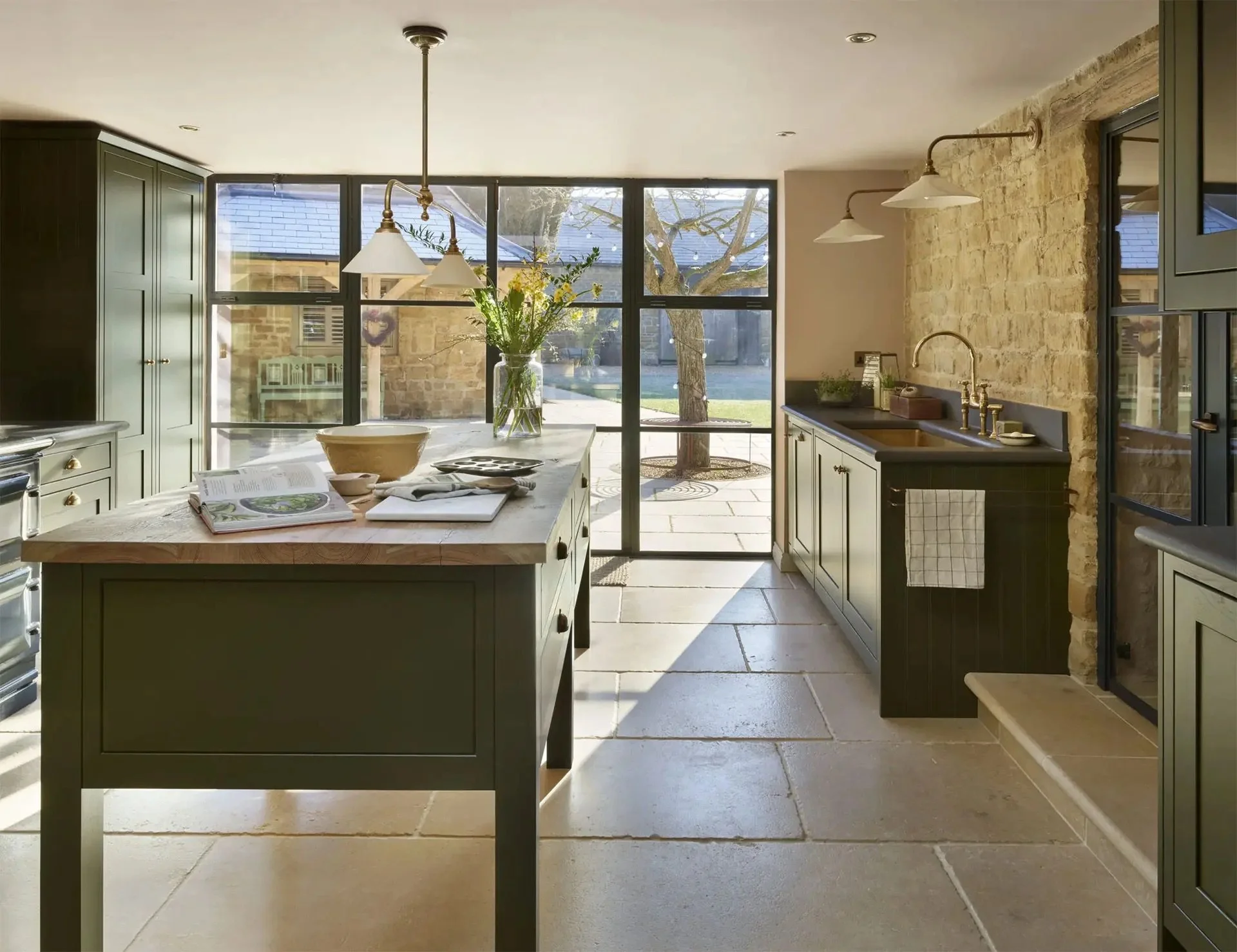
The table sits alongside the Haddon in-frame range, finished in a deep green paint colour matched at the Kitchen Makers factory in Coventry, with open shelving, a glazed dresser for glassware, and a floor-to-ceiling cupboard completing the room. On the dining side, the cabinetry shifts to a contrasting mustard tone, with a family-sized wooden dining table and benches continuing the look beyond the working area.
This is the English country-house version of the idea: a scullery table with drawers for utensils and cutlery, built to take the daily wear of family cooking and hold its own as a piece of furniture in a room already full of character. It suits a classic kitchen where the client wants warmth, natural materials and the sense of a room put together over time.
The Next125 Version: Precision Engineering as the Centrepiece
Next125's Cooking Table takes the same starting point, a freestanding alternative to the built-in island, and builds it for a different kind of kitchen entirely. Where the Kitchen Makers table is a working surface with storage built in, the Next125 table is closer to a design object: slim legs, a worktop that integrates a hob directly into its surface, and an extraction system, either a downdraft unit built into the table or a hood positioned above it, so nothing needs to interrupt the clean lines of the piece.
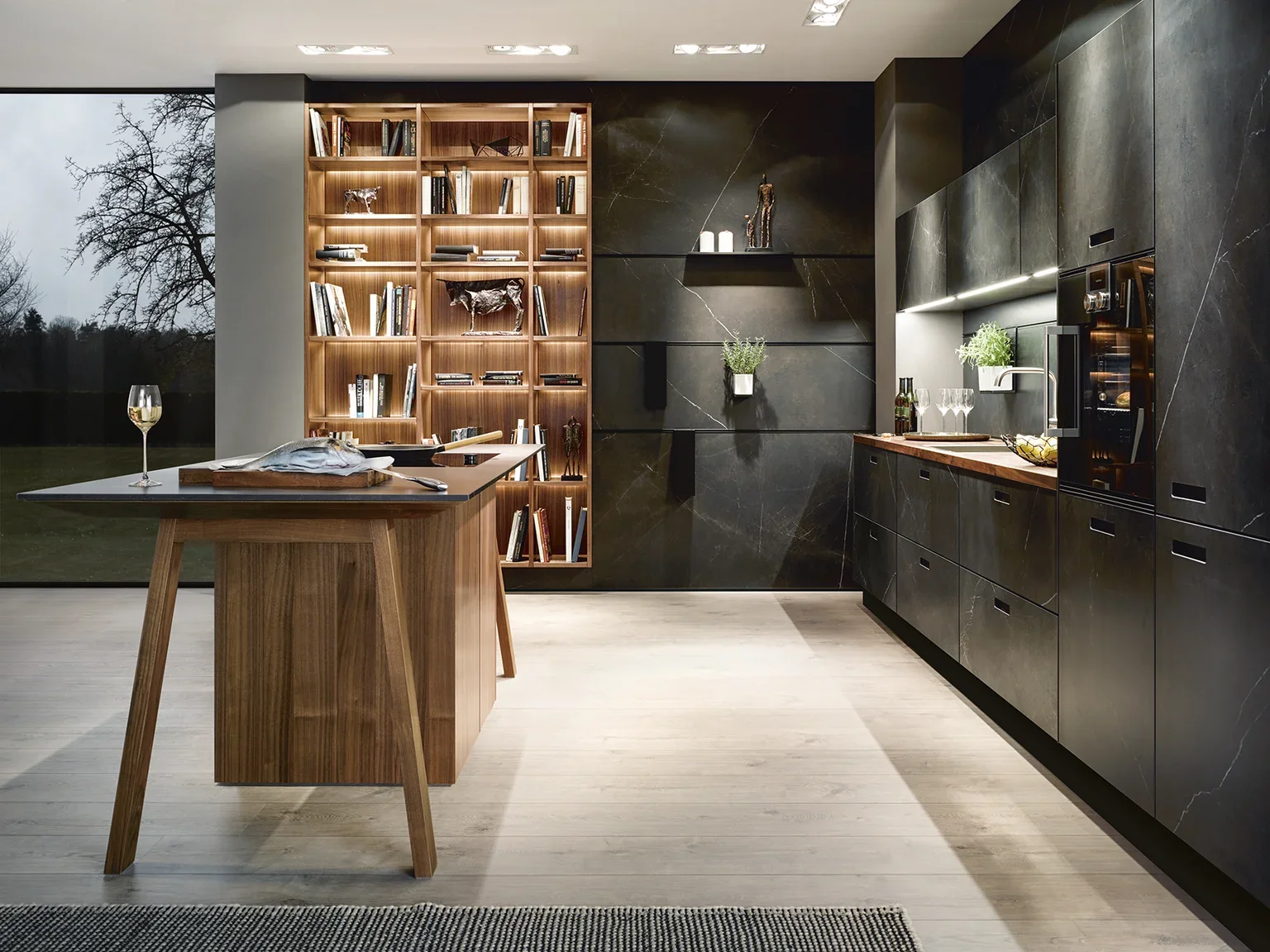
It's available in oak, natural walnut or smoked, brushed larch, with a lighting detail built into the frame beneath the worktop. Next125 have picked up design awards for it, which tells you where the emphasis sits: this is a table designed to be looked at from every angle, in a kitchen with little else competing for attention.
It suits a modern kitchen where the client wants a single engineered object at the centre of the room, in a material and finish chosen to stand entirely on its own.
Two Answers to the Same question
Put the two tables next to each other, and the differences are the point. Kitchen Makers builds a table for a room already full of character, painted cabinetry, open shelving, a dresser, where the table needs to work hard and look at home. Next125 builds a table for a room where the table itself is the character, and everything else is kept quiet around it.
Both solve the same problem the fitted island always struggled with: putting real cooking capability at the centre of a room, built as furniture and free of the room's fixed cabinetry. Neither needs a sink or bin built in to earn its place. Both ask you to think about how you actually want to stand, prep and gather, before you think about storage.
Which one is right for a kitchen depends entirely on the room it's going into, the other pieces around it, and how the client wants the space to feel day to day. That's exactly the kind of decision worth working through with a designer before any of it is drawn, not after.
If a freestanding table sounds like the right starting point for your own kitchen, arrange a design consultation and we'll talk through which direction suits your space.